

IPSNEWS

Nueva prórroga para la MVe y facilidades en el expediente digital
El Servicio de Administración Tributaria (SAT) dio a conocer en su portal la Tercera Versión Anticipada de la Segunda Resolución de Modificaciones a las Reglas Generales de Comercio Exterior (RGCE) para 2026. Esta publicación confirma la extensión del periodo de transición para la implementación de la Manifestación de Valor Electrónica (MVe) hasta el 30 de septiembre de 2026, fijando el inicio de su obligatoriedad a partir del 1 de octubre de 2026.

COFEPRIS optimizes the Advertising Notice for cosmetic products
As of July 15, 2026, the Federal Commission for the Protection against Sanitary Risk (Cofepris) and the Digital Transformation and Telecommunications Agency (ATDT) enabled an improvement in the DIGIPRIS platform that allows companies in the cosmetic sector to select multiple distribution channels in a single Advertising Notice for Cosmetic Products per brand.
New COFEPRIS Guide: Optimization and agility in the Sanitary Registration of Medical Devices
Seeking to unify current Equivalence Agreements and the Abbreviated Regulatory Pathway, the Federal Commission for Protection against Sanitary Risks (COFEPRIS) has published the Requirements Guide for the Sanitary Registration of Medical Devices.

Dietary Supplement classification: Scope of the new COFEPRIS Guide
COFEPRIS has published the "Non-Regulatory Guide for the Classification of Products as Dietary Supplements." This technical document compiles the requirements of national legislation through a self-assessment format and a decision-making diagram to determine whether a product belongs in this category.
Prórroga de la Manifestación de Valor Electrónica
El pasado 02 de junio de 2026, el Servicio de Administración Tributaria (SAT) dio a conocer la versión anticipada de la segunda resolución de modificaciones a las Reglas Generales de Comercio Exterior (RGCE) para el presente ejercicio. En dicha publicación, se establece formalmente la extensión del plazo de obligatoriedad para transmitir la Manifestación de Valor electrónica (MVe) hasta el 31 de julio de 2026.

RAUpdate: Prohibition of Erythrosine (Red 3 FD&C) in the Mexican Food Industry
The Mexican Ministry of Health (Secretaría de Salud) has issued an Agreement to eliminate the use of the coloring agent Erythrosine and its lakes (Red 3 FD&C) in food, beverages, and dietary supplements. This measure responds to a risk analysis that determined that the population's exposure exceeds internationally established safety limits.
RAUpdate New NOM-137-SSA1-2025: Requirements for Medical Device labeling in Mexico
On May 19, 2026, Mexico's Ministry of Health published the new NOM-137-SSA1-2025 in the Official Gazette of the Federation (DOF), which completely replaces the version in force since 2008.

Dietary Supplement labeling: COFEPRIS compliance guide
This article details the technical and legal requirements that must be met by labels for dietary supplements marketed in Mexico. Its objective is to provide manufacturers, importers, and distributors with a clear roadmap to ensure their products present truthful information, avoiding omissions that compromise transparency toward the consumer. The correct implementation of these elements ensures that the product remains within the current sanitary legal framework before COFEPRIS.
RAUpdate Administrative modernization of COFEPRIS: Streamlining procedures
The administrative reform published on May 4, 2026, is focused on the digitalization and operational efficiency of The Federal Commission for Protection against Sanitary Risks (COFEPRIS). The analysis covers the elimination of physical requirements, the consolidation of procedure codes (homoclaves) regarding advertising, and the acceleration of medical device procedures.
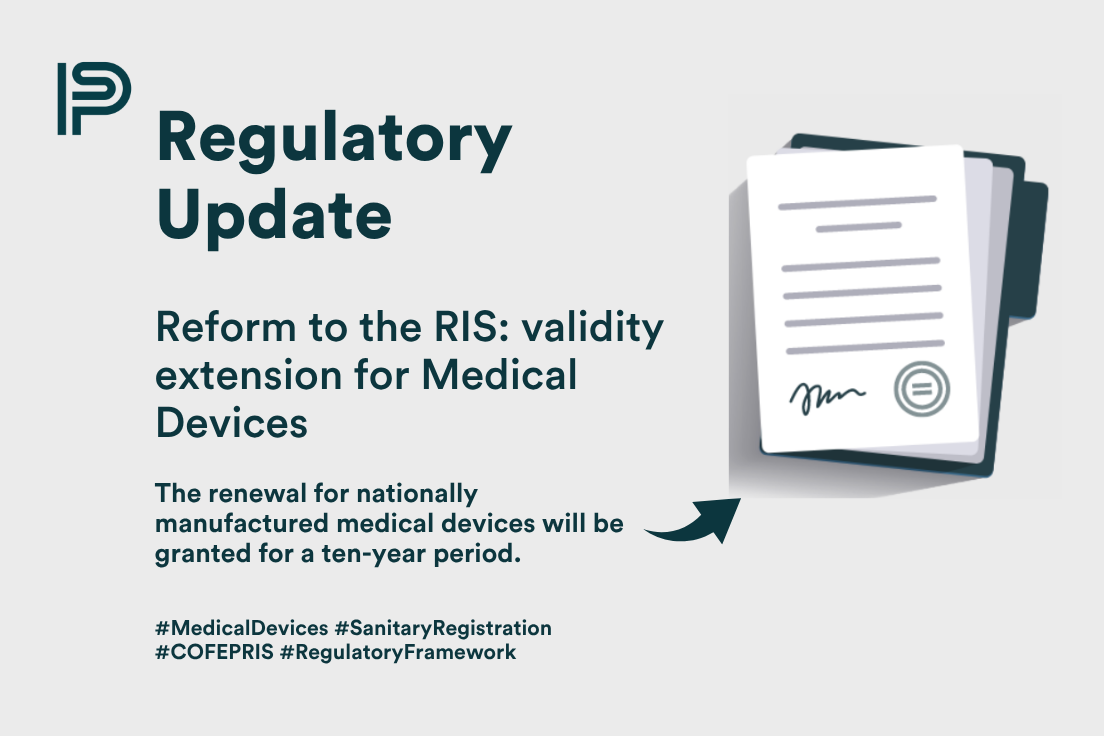
RAUpdate Reform to the Regulations for Health Supplies (RIS): Validity extension for Medical Devices
The Federal Commission for Protection against Sanitary Risks (COFEPRIS), through the Official Gazette of the Federation (DOF), updated some articles of its Regulations for Health Supplies (RIS, its acronym in Spanish), which helps to improve and reduce processing times.