
New COFEPRIS Guide: Optimization and agility in the Sanitary Registration of Medical Devices
In response to the growing need to accelerate access to safe and quality medical technologies, the publication of the new Requirements Guide for the Sanitary Registration of Medical Devices in Mexico has been formalized. This document unifies pre-existing Equivalence Agreements and introduces the Abbreviated Regulatory Pathway based on the global Reliance model. The strategy promises to reduce administrative backlogs and profoundly transform the Time-to-Market in the Mexican healthcare sector.
UPDATE
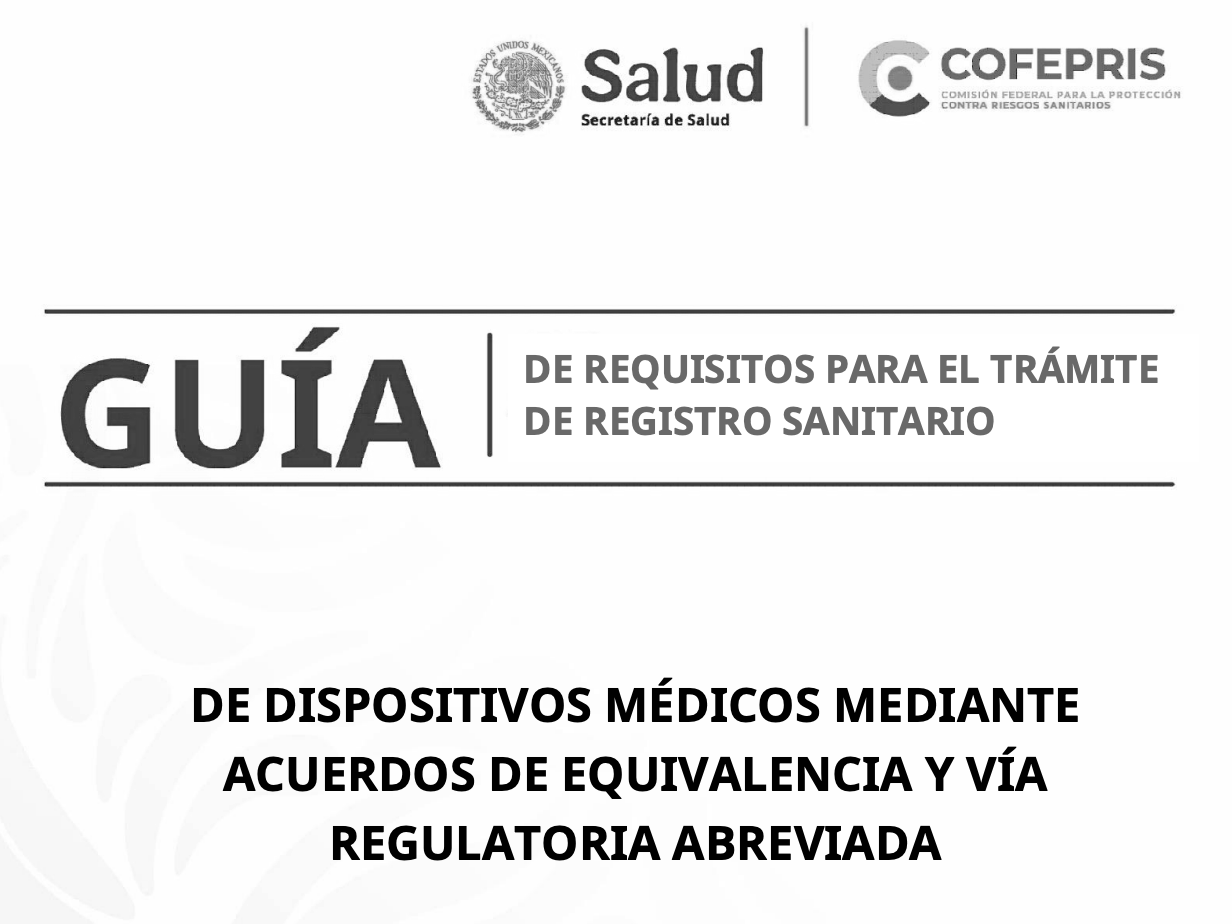
The regulatory affairs landscape in Mexico is undergoing one of its most significant evolutions. Seeking to unify current Equivalence Agreements and the Abbreviated Regulatory Pathway, the Federal Commission for Protection against Sanitary Risks (COFEPRIS) has published the Requirements Guide for the Sanitary Registration of Medical Devices.
The published Guide is a comprehensive technical document aimed at optimizing the procurement of sanitary registrations for medical devices. This effort responds to global convergence guidelines and seeks to replace redundant processes with smart and shared evaluation mechanisms alongside the most rigorous health agencies in the world.
Key elements of the new Guide.
The Requirements Guide for the Sanitary Registration of Medical Devices through Equivalence Agreements and Abbreviated Regulatory Pathway primarily serves as an indispensable roadmap for medical device regulatory affairs professionals, precisely breaking down the administrative, legal, and technical requirements to submit successful applications through the official format published by COFEPRIS on its official platform. Among its key elements, the following stand out:
Structure of window options: applicants must clearly identify and select the applicable pathway in the application (Options A, B, and C for FDA/Canada; D and E for Japan; and the new Option F for the Abbreviated Regulatory Pathway).
Critical flexibility in Good Manufacturing Practices (GMP): the guide introduces alternative options in the absence of the FDA's Establishment Inspection Report (EIR), accepting audit reports or ISO 13485:2016 certificates issued by accredited bodies under the MDSAP (Medical Device Single Audit Program) scheme.
Invariable technical substantiation: the streamlining of timelines does not exempt compliance with quality and safety. The rigorous submission of the descriptive Technical Monograph, lists of accessories and models, signed summaries of stability studies (real-time or accelerated), and biocompatibility tests is required.
Local identity and vigilance: it is emphasized that labeling must strictly comply with the current version of NOM-137-SSA1, and the holder's processes must immediately engage with NOM-240-SSA1 regarding Technovigilance.
Key concept - reliance: the guide formalizes the international principle of regulatory reliance, where COFEPRIS leverages technical analyses already performed by peer international agencies, optimizing resources without compromising sovereignty or the population's sanitary safety.
The formal publication of this Guide constitutes the unification into a single instrument of the technical criteria for current Equivalence Agreements (with the U.S., Canada, and Japan) and formally incorporates the new Abbreviated Regulatory Pathway.
Regulatory relevance of the new guide
The implementation of the Abbreviated Regulatory Pathway and the publication of the Guide have a direct impact on the adoption and institutionalization of the principles of Reliance (Regulatory Reliance) and International Recognition. By no longer evaluating "from scratch" the safety and efficacy of a device that has already been rigorously analyzed by a high-vigilance agency, it allows COFEPRIS to optimize its resources and reduce resolution times. This drastically reduces redundant administrative barriers, abates the backlog of applications, and modernizes the Mexican regulatory framework, aligning it with the guidelines of the Organisation for Economic Co-operation and Development (OECD).
REGULATORY FRAMEWORK
The legal architecture of the Requirements Guide for the Abbreviated Regulatory Pathway and Equivalence Agreements does not emerge in isolation, but rather consolidates a robust regulatory framework structured over recent years:
Equivalence Agreements, previously established: The pathways for obtaining sanitary registration in Mexico for medical devices previously authorized by the Food and Drug Administration (FDA) and Health Canada (under the original Agreement published in 2010), as well as by the Ministry of Health, Labour and Welfare (MHLW) and the Pharmaceuticals and Medical Devices Agency (PMDA) of Japan (under the Agreement published in 2012), are maintained and refined.
The new Abbreviated Regulatory Pathway: It is legally grounded in the General Guidelines for the adoption of abridged regulatory pathways, officially published on July 18, 2025. This addition empowers the formal recognition of decisions from other Regulatory Authorities of Reference (RAR) and the World Health Organization (WHO) prequalification program.
EFFECTS FROM RAUPDATE
The systemic adoption of the guidelines outlined in this Guide projects a multifactorial and highly positive impact for both the business fabric and the public health system:
Commercial Impact (Time-to-Market): It allows companies to plan product launches in Mexico much more agilely, accelerating the entry of technological innovations into the public and private markets.
Administrative Unlocking: It offers real solutions to companies whose registrations were frozen due to the lack of a recent physical inspection report (EIR) from the FDA, opening the door to the use of their ISO 13485 certification under MDSAP.
Demand for Internal Rigor: It forces Regulatory Affairs departments to implement flawless discipline. Given that the guide requires strict concordance across documents (the name, model, accessories, and manufacturer on the foreign certificate must exactly match the draft of the local label in Spanish), any oversight or lack of traceability will cause official requests for information (prevenciones) or rejections.
Sanitary Co-responsibility: It closely links local distributors with foreign manufacturers to ensure that the safety profile remains active in the country through compliance with the labeling NOM (NOM-137-SSA1) and Technovigilance (NOM-240-SSA1). Mexico's Global Positioning: By embracing the standards of the International Medical Device Regulators Forum (IMDRF), the country aligns itself with OECD best practices, facilitating trade and making Mexico a highly attractive destination for international medical device manufacturers.
Written by:

Mauricio Amaro
Senior Regulatory Affairs Analyst at Insumos para la Salud, S.A. de C.V. with extensive experience in the sanitary regulation of medical devices. Specialist in the comprehensive management of registrations before COFEPRIS, dossier evaluation, and coordination of efficacy evaluation projects with accredited national laboratories.
About IPS
At IPS, we specialize in guiding the medical device industry through regulatory compliance. With our extensive experience in the sanitary regulation of medical devices, we are experts in designing and implementing effective strategies tailored to the requirements and guidelines of the Equivalence Agreement pathway and the Abridged Regulatory Pathway. Our team of experts not only understands the regulations, but also translates these guidelines and simplifies regulatory complexity to accelerate the market entry of health technologies in Mexico.
Contact us: info@insumosparasalud.com